The trust agreement says one thing. The system of record says another. Who notices?
Every trust you administer is governed by a legal instrument written in prose and a system of record written in codes. The gap between them is where fiduciary risk lives. r.Team closes that gap with a Trust Ontology with Securities Law and a Reasoning Engine that reads the instrument the way your best administrator does — and shows its work.
Interpretation happens in people’s heads. The system of record never hears about it.
A trust agreement is the governing law of the account. It names who may receive what, under which standard, at whose discretion, and with what limits on investment. Yet the trust accounting system holds only a shorthand version of all that: an account type, an income/principal setting, a few distribution flags, perhaps a free-text note.
When the two drift apart — a spendthrift clause the system doesn’t know about, a concentration the instrument permits but policy forbids, a successor-trustee trigger nobody coded — the trust company carries the liability. The administrator who understood the instrument may have left. The reasoning behind a prior decision was never written down. And a securities-law question (is this holding permissible? is this loan self-dealing?) has to be answered from memory, every time.
What a trust company actually deals with
A 60-page instrument, three amendments, and a distribution request due Friday.
Discretionary standards (“health, education, maintenance and support”) that live in a paragraph, not a field.
Account codes set up years ago by someone who has since retired.
An examiner who will ask, “Show me why you decided that.”
Where the gap shows up Daily
A distribution request is approved against the account setup, not against the instrument’s actual standard.
A trustee-removal or grantor-death trigger is discovered after the fact, in a file review.
A prudent-investor or concentration question is answered differently by two officers on the same account.
Accountings go to the wrong parties, or on the wrong schedule, because the instrument’s reporting clause was never captured.
An examiner asks for the basis of a decision and receives an opinion, not a record.
What it is
What a Trust Ontology with Securities Law is — and how it is produced
A trust ontology is a structured map of the legal concepts that govern a trust and the ways those concepts connect. Add the securities laws and fiduciary standards a trust company operates under, and you have a map that an AI can follow instead of guess at. Here is how a legal document becomes something a Reasoning Engine can actually reason over, in plain language.
The three pieces
Piece 1
The Instrument
The trust agreement itself — the raw material. It names the trustee, the beneficiaries, the duties, the powers, and how the trust is to be managed. On its own it is a long pile of words; the Reasoning Engine cannot “understand” it the way a person does until it has been processed.
Piece 2
The Ontology — the dictionary
A structured glossary of the key legal terms — trustee, beneficiary, fiduciary duty, conflict of interest, distribution, prudent investor, concentration limit — and how they relate. It gives the engine a shared language: in this context, “duty” means a legal obligation that must be followed, not a general-purpose word.
Piece 3
The Knowledge Graph — the map
The dictionary is a flat list. The graph is a live map: each concept is a place, each relationship is a road. Trustee → has duty to → Beneficiary. Fiduciary duty → requires → acting in good faith. Conflict of interest → may require → recusal. You can trace a path from one idea to another and add new roads without redrawing the map.
Why a map instead of a list
A list is like the index at the back of a book — static, and it never shows the bigger picture. A map lets the engine follow connections that are several steps apart, the way real law works:
Trustee → has duty → Fiduciary duty → requires → Proper management → includes → Record-keeping → can be reviewed by → Beneficiaries Failure to manage properly → may result in → Removal
If the question is whether beneficiaries can review records, the map traces that path. A list would show only the first link, and the AI would have to guess the rest.
What the map adds
Hidden connections. Indirect, multi-step relationships are found automatically rather than assumed.
Focus. Only the concepts connected to your question are brought forward — a spotlight, not a flood.
Scale. Thousands of concepts can live in the map without crowding out the question.
Inference. The engine can reason that a conflict of interest may lead toward misappropriation even when the instrument never uses that word.
Currency. New rulings or policy changes update the map; the method stays the same.
How it is produced — step by step
01
The instrument is broken into searchable pieces
Each paragraph or clause gets a “meaning fingerprint” so it can be found by what it means, not only by the words it uses. Ask about removing a trustee who isn’t doing the job, and the clauses about duties, standards and removal surface even if none of them says “isn’t doing the job.”
02
The right clauses are retrieved
The engine searches the instrument for the handful of clauses most relevant to the question — and only those. Nothing is invented; nothing outside the instrument is treated as the instrument.
03
The concepts are looked up on the map
The engine finds the concept in the ontology (say, “trustee”) and follows its connections — to fiduciary duty, to conflict of interest, to accountability, to the securities-law standards that apply — so the clause is read in its full legal context.
04
The question, the clauses and the map are combined
The engine is handed three things at once: your question, the exact excerpts retrieved from the instrument, and the chain of relationships from the map. It is told to answer using those and to cite both.
05
The answer is written — and the reasoning is recorded
The result is grounded in the specific text and the broader legal structure behind it, with the instrument clauses and ontology concepts it relied on shown alongside. That record is what makes the judgment defensible later.
Piece
What it does
The analogy
Ontology
Defines the legal terms and their basic relationships, including the securities-law and fiduciary standards that apply
A dictionary or glossary
Knowledge Graph
Maps how the concepts connect, in a form that can be traced and queried
A map of a city’s streets
Instrument Index
Makes the trust agreement searchable by meaning
A smart search engine for the document
The ontology tells the engine what the words mean. The map tells it how the concepts connect. The index finds the right text in the instrument. Together, the answer rests on the full web of legal meaning behind the words, not on the words alone.
Why it matters
Why a Trust Ontology with Securities Law is important for trust administration
A trust ontology that encodes securities laws matters because every firm that touches a trust — the trust company that administers it, the investment adviser that manages its assets, the estate planner who designs it, and the law firm that drafts and defends it — is reasoning about the same assets under different but overlapping bodies of law. State trust codes, the prudent investor rule, the Investment Advisers Act, national-bank fiduciary regulation, ERISA, and the rules on income and principal all impose obligations about what may be held, how it must be diversified, who owes what disclosure, and what records must exist to prove the fiduciary acted properly.
Today each profession carries its own partial version of those rules — in policy manuals, investment policy statements, drafting checklists, and the experience of senior staff — and the hand-offs between them are where mistakes and liability accumulate. An ontology makes the rules explicit and shared: it formally links the entities everyone works with (trust, grantor, beneficiary, trustee, adviser, account, security, transaction) to the legal concepts that govern them (duty of loyalty, prudence, concentration limit, prohibited transaction, suitability, distribution standard, income/principal classification).
The payoff, by role
Trust company. Test whether a holding, trade or distribution is permissible under the governing instrument and law before it settles — and produce an audit trail examiners accept.
Investment adviser. Demonstrate that advice was suitable for the trust’s purposes and beneficiaries, not just a generic risk profile, satisfying both fiduciary and Advisers Act obligations.
Estate planner. See how a drafting choice — a discretionary standard, a directed-trustee provision, a retained-asset clause — will constrain investment and administration later.
Law firm. Trace, in litigation or review, exactly which rule applied to which decision and why.
The common thread: one shared, machine-readable definition of fiduciary conduct — which is what lets AI reason within the law rather than around it, and turns four disconnected views of a trust into one defensible record of how it was administered.
The Reasoning Engine
It doesn’t replace the trust officer’s judgment. It makes that judgment defensible.
The Reasoning Engine starts where your people start — with a question, an instinct, a creative reading of a hard clause. It then does the part that is slow, repetitive and easy to get wrong under deadline: it retrieves the exact clauses, pulls the governing concepts from the ontology, lays the chain of reasoning out in the open, and records the whole thing.
The human still decides. What changes is that the decision now has a visible basis — the instrument cited, the law applied, the path from one to the other — that a reviewer, a successor trustee or an examiner can follow years later. Human insight goes in; a defensible, repeatable judgment comes out.
Because the interpretation is now explicit, it can be checked against the account setup in the system of record. Where the two disagree, the disagreement surfaces as a finding, not a surprise.
Grounded only
Every answer is built solely from clauses retrieved from the instrument and concepts retrieved from the ontology. If it isn’t in either, the engine says so instead of filling the gap.
Cited both ways
Each judgment shows which instrument clauses and which ontology concepts it relied on, so the basis can be verified line by line.
Human decides
The engine proposes a reading and shows its work. Discretionary decisions, distributions and exceptions remain with the trust officer and the committee.
Ledgered
Every question, the instrument cited, the ontology applied and the decision tier are written to a Judgment Ledger — the record you hand to an examiner or a court.
Private, always
Personal information never leaves your trust.
A trust instrument is among the most personal documents a family will ever sign. It names children, health circumstances, marriages, business interests and the reasons behind each of them. r.Team is built on the principle that this information is read privately and stays private.
How it operates
Each trust’s instrument, index and reasoning run inside that trust’s own private space. One trust cannot see another.
The instrument is indexed and reasoned over for the trust company that administers it — never pooled, never used to train a general-purpose model.
The ontology is shared; the personal facts are not. The map of legal concepts is common to every trust, but the names, amounts and family circumstances stay with the trust they belong to.
Access is by named, verified individuals, and every question asked is recorded in the Judgment Ledger — so privacy and accountability come from the same mechanism.
What the demonstration uses Synthetic
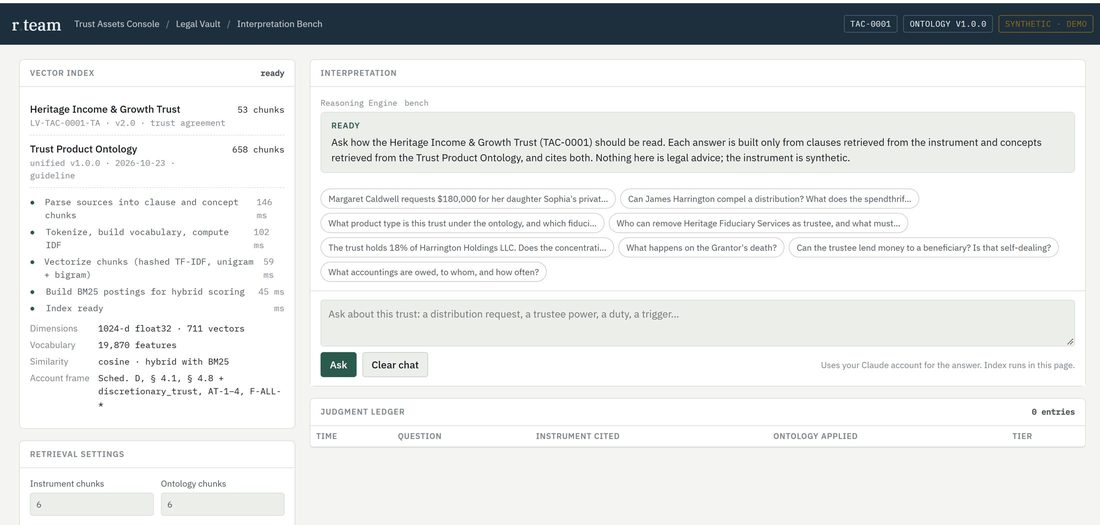
The demonstration on this page runs against a synthetic instrument — the Heritage Income & Growth Trust (TAC-0001) — with invented parties, assets and clauses. Nothing in it is a real family, a real account or legal advice. It exists so a trust company can see how the Reasoning Engine reads an instrument before it reads one of yours.
When you bring a real instrument, it is read in a private space provisioned for that trust alone, under your firm’s control.
Demonstration
The Interpretation Bench
This is the working surface. On the left, the instrument and the ontology are indexed and ready. In the center, you ask how the trust should be read — a distribution request, a trustee power, a duty, a trigger — and the engine answers from the instrument and the ontology, citing both. Below, every judgment is written to the ledger.
Access is password-gated. Request a Demonstration Password and we will send one. The bench itself runs against a synthetic instrument. Nothing on it is legal advice.